Money and Banking
What money is and why we use it, how banks create credit, and how the central bank controls the nation's money.
The big idea
Think first
Banks lend out money that savers believe is sitting safely in their accounts. How can the same rupee seem to be in two places at once, and who keeps the whole system honest?
Imagine trying to buy groceries by swapping a chicken for vegetables. That is a world without money. Money makes exchange easy, and the banking system built on it stores our savings, lends for investment, and even creates new money. Understanding money, banks and the central bank is at the core of how a modern economy works.
Functions of money
Money is anything generally accepted as payment for goods and services. Before money, people relied on barter (directly swapping goods), which was clumsy because it needed a "double coincidence of wants". Money solves this by performing four key functions:
- a medium of exchange: accepted by all in trade,
- a measure (unit) of value: prices everything in common terms,
- a store of value: wealth can be saved for later, and
- a standard of deferred payment: debts can be settled over time.
Modern money, such as paper currency, has no value in itself. It is accepted because the government authorises it. The rupee is issued by the Reserve Bank of India on behalf of the government.
Previous-year questions
Previous-year question
2018UPSCWhich one of the following statements correctly describes the meaning of legal tender money?
Measures of money supply
The total stock of money in the economy is measured through standard aggregates. M1 (narrow money) is the most liquid measure. It consists of currency with the public, demand deposits with banks, and other deposits with the RBI. M3 (broad money) adds time deposits with banks to M1. M3 is therefore the sum of currency with the public, demand deposits, time deposits and other deposits with the RBI, and it is the most watched measure of money supply in India.
Liquidity falls in a clear order. Currency is the most liquid asset. Demand deposits come next because they can be withdrawn instantly. Savings deposits carry some restrictions, and time deposits are the least liquid because of their lock-in period. Note one classic trap: withdrawing cash from a demand deposit leaves the total money supply unchanged. The withdrawal merely converts one component of money (a deposit) into another (currency in hand).
Previous-year questions
Previous-year question
2020UPSCIf you withdraw 1,00,000 in cash from your Demand Deposit Account at your bank, the immediate effect on aggregate money supply in the economy will be:
Previous-year question
2013UPSCConsider the following liquid assets:
- Demand deposits with the banks
- Time deposits with the banks
- Savings deposits with the banks
- Currency
The correct sequence of these assets in decreasing order of liquidity is:
Previous-year question
2002UPSCConsider the following:
- Currency with the public
- Demand deposits with banks
- Time deposits with banks
Which of these are included in Broad Money (M3) in India?
Previous-year question
1997UPSCThe sum of which of the following constitutes Broad Money in India? I. Currency with the Public II. Demand deposits with banks III. Time deposits with banks IV. Other deposits with RBI Choose the correct answer using the codes given below:
Commercial banks and credit creation
Commercial banks are the institutions where most people keep their money. They do two basic things: accept deposits from savers and lend money to borrowers. They charge more interest on loans than they pay on deposits. This interest difference is a bank's main source of income. Banks thus connect savers with borrowers and put idle money to productive use.
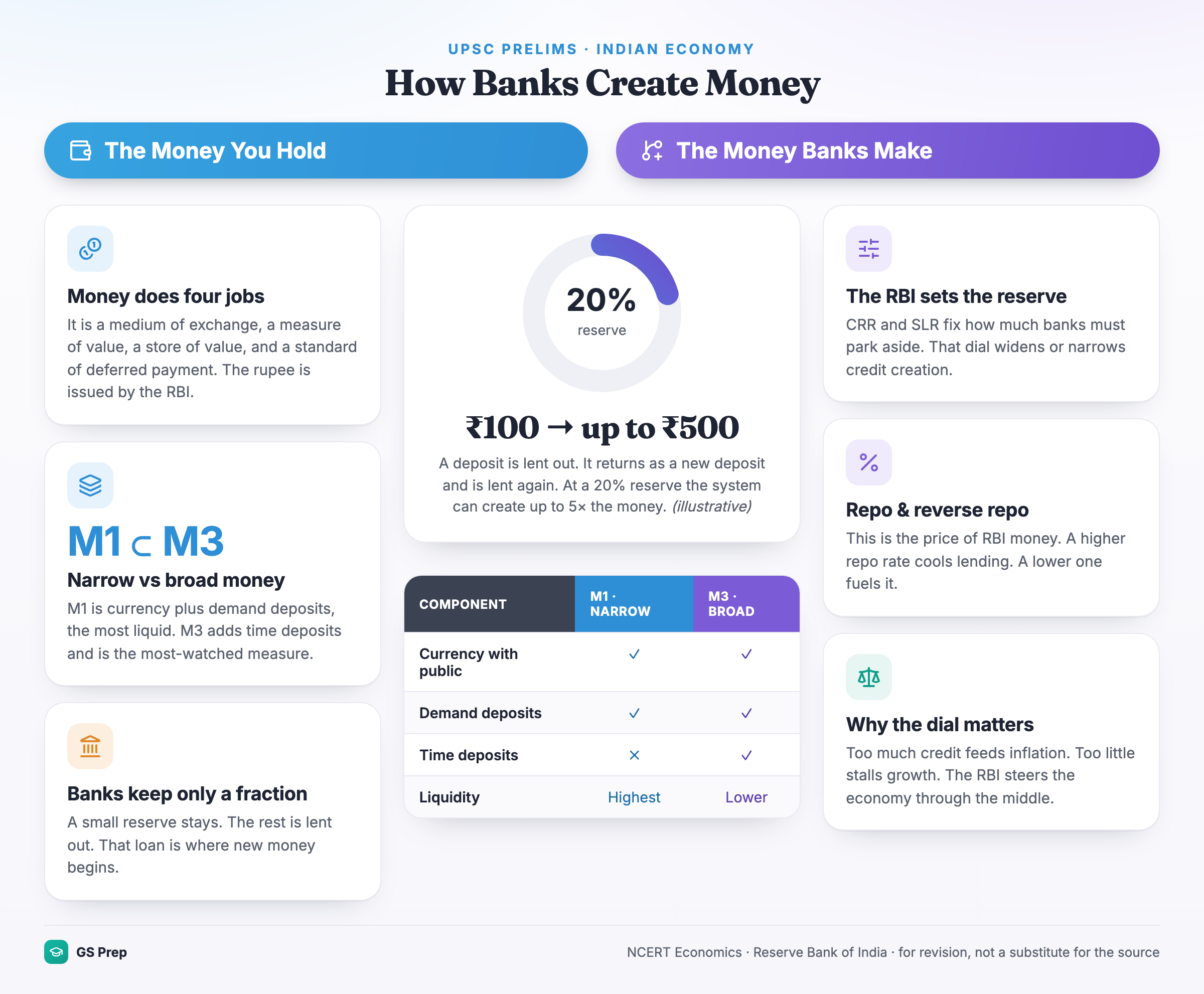
Crucially, banks do not keep all deposits idle. They keep only a fraction as reserve and lend out the rest. When that loan is spent and re-deposited, it can be lent again, and so on. In this way the banking system creates credit, expanding the total money supply far beyond the original deposits.
Previous-year questions
Previous-year question
2021UPSCThe money multiplier in an economy increases with which one of the following?
Previous-year question
2019UPSCWhich of the following is not included in the assets of a commercial bank in India?
Previous-year question
2010UPSCConsider the following statements: The functions of commercial banks in India include
- Purchase and sale of shares and securities on behalf of customers.
- Acting as executors and trustees of wills.
Which of the statements given above is/are correct?
Previous-year question
2010UPSCIn India, the interest rate on savings account in all the nationalized commercial banks is fixed by:
Credit and collateral
Credit means a loan: an agreement in which the lender gives money, goods or services in return for repayment later, usually with interest. Credit can cut two very different ways:
- Helpful credit: a farmer or trader who borrows to invest can earn more and repay easily. The borrower ends up better off.
- Debt trap: if the investment fails, for example when a crop is ruined, the borrower may have to sell land or other assets to repay. The borrower ends up worse off.
To protect themselves, lenders usually demand collateral: an asset such as land, a house or jewellery that the borrower pledges and the lender can seize if the loan is not repaid.
Check yourself
A farmer borrows to sow a crop, the crop is ruined, and he must sell his land to repay the loan. What does this situation illustrate?
Formal and informal credit
Loans come from two broad kinds of sources:
- Formal sources: banks and cooperatives. They charge lower interest, follow fair terms, and are supervised by the Reserve Bank of India.
- Informal sources: moneylenders, traders and friends. They charge very high interest, follow no rules, and often exploit poor borrowers, deepening their debt.
A major goal of development is to expand cheap formal credit to everyone, especially the rural poor, who still depend heavily on moneylenders.
Check yourself
Which feature marks a formal source of credit?
The central bank (RBI)
At the top of the system sits the central bank, which in India is the Reserve Bank of India (RBI). It is the banker's bank and the guardian of the nation's money. Its main roles are:
- to issue currency (banknotes),
- to act as banker to the government and to other banks,
- to regulate and supervise commercial banks, and
- to control the money supply and credit through monetary policy, for example by changing interest rates or reserve requirements.
By tightening or loosening money, the RBI keeps inflation in check while supporting growth. This makes it one of the most powerful economic institutions in the country.
Monetary policy tools
The RBI controls credit with two families of instruments. Quantitative tools act on the overall volume of money in the economy:
- Repo rate: the rate at which commercial banks borrow short-term from the RBI against government securities. It is the benchmark policy rate.
- Bank rate: the rate at which the RBI discounts (rediscounts) bills of exchange and commercial paper for banks. It is not the rate banks charge their customers, and it is not the rate banks pay on deposits.
- Cash Reserve Ratio (CRR): the fraction of deposits that banks must park with the RBI as cash.
- Statutory Liquidity Ratio (SLR): the fraction of deposits that banks must hold in liquid assets such as cash, gold and approved government securities. Because banks meet the SLR largely by holding government securities, the SLR is also the mechanism through which bank credit flows to the government.
- Open market operations: the RBI's buying and selling of government securities to inject or absorb liquidity.
Selective credit controls, by contrast, steer credit toward or away from particular uses. They include margin requirements, regulation of consumer credit, and rationing of credit. Variable reserve ratios such as the CRR and SLR are quantitative tools, not selective ones.
Since 2016 the benchmark repo rate has been set by the Monetary Policy Committee (MPC), a six-member statutory body chaired by the RBI Governor, not by the Finance Minister. The Narasimham Committee on financial sector reforms recommended reducing the SLR, the CRR and priority sector financing, so that banks could lend more freely on commercial judgement.
The RBI's standing and income
The RBI Governor is appointed by the Central Government and draws his powers from the RBI Act, 1934. No provision of the Constitution empowers the government to issue directions to the RBI. The RBI earns its income from buying and selling government bonds, from dealing in foreign currency, and from issuing currency. It does not manage pension funds, and it does not lend to private companies. One administrative quirk recurs in exams: the RBI's accounting year ran from July to June, unlike the Government of India's April–March financial year.
Previous-year questions
Previous-year question
2025UPSCWhich of the following are the sources of income for the Reserve Bank of India? I. Buying and selling Government bonds II. Buying and selling foreign currency III. Pension fund management IV. Lending to private companies V. Printing and distributing currency notes Select the correct answer using the code given below.
Previous-year question
2023UPSCConsider the following statements:
Statement-I: In the post-pandemic recent past, many Central Banks worldwide had carried out interest rate hikes.
Statement-II: Central Banks generally assume that they have the ability to counteract the rising consumer prices via monetary policy means. Which of the following is correct in respect of the above statements?
Previous-year question
2022UPSCIn India, which one of the following is responsible for maintaining price stability by controlling inflation?
Previous-year question
2021UPSCConsider the following statements: 1) The Governor of the Reserve Bank of India (RBI) is appointed by the Central Government. 2) Certain provisions in the Constitution of India give the Central Government the right to issue directions to the RBI in public interest. 3) The Governor of the RBI draws his power from the RBI Act. Which of the above statements are correct?
Previous-year question
2021UPSCIn India, the central bank's function as the 'lender of last resort' usually refers to which of the following? 1) Lending to trade and industry bodies when they fail to borrow from other sources 2) Providing liquidity to the banks having a temporary crisis 3) Lending to governments to finance budgetary deficits Select the correct answer using the code given below.
Previous-year question
2020UPSCIf the RBI decides to adopt an expansionist monetary policy, which of the following would it not do?
- Cut and optimize the Statutory Liquidity Ratio
- Increase the Marginal Standing Facility Rate
- Cut the Bank Rate and Repo Rate
Select the correct answer using the code given below:
Previous-year question
2017UPSCWhich of the following statements is/are correct regarding the Monetary Policy Committee (MPC)?
- It decides the RBI's benchmark interest rates.
- It is a 12-member body including the Governor of RBI and is reconstituted every year.
- It functions under the chairmanship of the Union Finance Minister.
Select the correct answer using the code given below:
Previous-year question
2015UPSCWhen the Reserve Bank of India reduces the Statutory Liquidity Ratio by 50 basis points, which of the following is likely to happen?
Previous-year question
2015UPSCWith reference to India economy, consider the following:
- Bank rate
- Open market operations
- Public debt
- Public revenue
Which of the above is/are component/components of Monetary Policy?
Previous-year question
2014UPSCIf the interest rate is decreased in an economy, it will:
Previous-year question
2014UPSCIn the context of Indian economy which of the following is/are the purpose/purposes of 'Statutory Reserve Requirements'?
- To enable the Central Bank to control the amount of advances the banks can create.
- To make the people's deposits with banks safe and liquid.
- To prevent the commercial banks from making excessive profits.
- To force the banks to have sufficient vault cash to meet their day-to-day requirements.
Select the correct answer using the code given below.
Previous-year question
2014UPSCThe terms 'Marginal Standing Facility Rate' and 'Net Demand and Time Liabilities', sometimes appearing in news, are used in relation to:
Previous-year question
2013UPSCAn increase in the bank rate generally indicates that the?
Previous-year question
2013UPSCIn the context of Indian economy, 'open market operations' refers to?
Previous-year question
2013UPSCSupply of money remaining the same when there is an increase in demand for money, there will be:
Previous-year question
2013UPSCThe Reserve bank of India regulates the commercial banks in matters of:
- Liquidity of assets
- Branch expansion
- Merger of banks
- Winding-up of banks
Select the correct answer using the codes given below.
Previous-year question
2012UPSCThe Reserve Bank of India (RBI) acts as a bankers' bank. This would imply which of the following?
- Other banks retain their deposits with the RBI.
- The RBI lends funds to the commercial banks in times of need.
- The RBI advises the commercial banks on monetary matters.
Select the correct answer using the codes given below:
Previous-year question
2012UPSCWhich of the following measures would result in an increase in the money supply in the economy?
- Purchase of government securities from the public by the Central Bank
- Deposit of currency in the commercial banks by the public
- Borrowing by the government from the Central Bank
- Sale of government securities to the public by the Central Bank
Select the correct answer using the codes given below:
Previous-year question
2011UPSCThe lowering of bank rate by the Reserve Bank of India leads to?
Previous-year question
2010UPSCWhen the Reserve Bank of India announces an increase of the Cash Reserve Ratio, what does it mean?
Previous-year question
2010UPSCWhich of the following terms indicates a mechanism used by commercial banks for providing credit to the government?
Previous-year question
2007UPSCConsider the following statements:
- The repo rate is the rate at which other banks borrow from the Reserve Bank of India.
- A value of 1 for Gini Coefficient in a country implies that there is perfectly equal income for everyone in its population.
Which of the statements given above is/are correct?
Previous-year question
2001UPSCConsider the following statements regarding Reserve Bank of India: I. It is a banker to the Central Government. II. It formulates and administers monetary policy. III. It acts as an agent of the Government in respect of India's membership of IMF. IV. It handles the borrowing programme of Government of India. Which of these statements are correct?
Previous-year question
1998UPSCThe accounting year of the Reserve Bank of India is:
Previous-year question
1998UPSCThe banks are required to maintain a certain ratio between their cash in hand and total assets. This is called:
Previous-year question
1995UPSCBank Rate implies the rate of interest:
Previous-year question
1995UPSCThe Narasimham Committee for Financial Sector Reforms has suggested reduction in:
Previous-year question
1995UPSCWhich one of the following is not an instrument of selective credit control in India?
Banking sector structure in India
Modern Indian banking began under colonial rule. The Oudh Commercial Bank, founded in 1881, was the first bank of limited liability managed by Indians. Today the commercial banking system contains public sector banks, private sector banks, foreign banks, regional rural banks and cooperative banks.
- Public sector (nationalised) banks: banks in which the government holds a majority stake. Corporation Bank, Dena Bank and Vijaya Bank were nationalised banks. Federal Bank, by contrast, is a private sector bank.
- Private sector banks: foreign direct investment in them is permitted up to 74 per cent, with up to 49 per cent under the automatic route. There is no rule capping the shareholding of Indian promoters at 49 per cent.
- Foreign banks: they may operate in India as branches or as wholly owned subsidiaries. A wholly owned banking subsidiary needs a minimum capital of Rs 500 crore, and at least half of its board members must be Indian nationals.
- Urban cooperative banks: regulated jointly by the RBI and the state registrars of cooperative societies, not by local boards of state governments. They can issue equity shares and preference shares. They were brought under the Banking Regulation Act, 1949 (the principal law governing banks) through an amendment in 1966.
Previous-year questions
Previous-year question
2024UPSCWith reference to the rule/rules imposed by the Reserve Bank of India while treating foreign banks, consider the following statements:
- There is no minimum capital requirement for wholly owned banking subsidiaries in India.
- For wholly owned banking subsidiaries in India, at least 50% of the board members should be Indian nationals.
Which of the statements given above is/are correct?
Previous-year question
2021UPSCWith reference to urban cooperative banks in India consider the following statements: 1) They are supervised and regulated by local boards set up by the state governments. 2) They can issue equity shares and preference shares. 3) They were brought under the purview of the Banking Regulation Act, 1949 through an Amendment in 1966. Which of the statements given above is/are correct?
Previous-year question
2006UPSCWhich one of the following Indian banks is not a nationalised bank?
Previous-year question
2003UPSCConsider the following statements:
- The maximum limit of shareholding of Indian promoters in private sector banks in India is 49 per cent of the paid up capital.
- Foreign Direct Investment up to 49 per cent from all sources is permitted in private sector banks in India under the automatic route.
Which of these statements is/are correct?
Previous-year question
2003UPSCIn India, the first bank of limited liability managed by Indians and founded in 1881 was:
Banking regulation and reforms
The Narasimham Committee (expert panels of 1991 and 1998) examined and suggested India's financial sector reforms. Internationally, the Basel Committee on Banking Supervision sets banking standards. Basel II laid down international standards for measuring the adequacy of a bank's capital. Basel III seeks to improve the banking sector's ability to deal with financial and economic stress and to improve risk management. The Capital Adequacy Ratio (CAR) is the amount of a bank's own funds held against risk-weighted assets to absorb losses when borrowers fail to repay. The RBI fixes the CAR following Basel norms. Individual banks cannot decide it for themselves.
Several RBI rules shape day-to-day banking:
- Priority Sector Lending: mandatory lending targets covering agriculture, micro and small enterprises, weaker sections, education and housing. All bank loans to MSMEs qualify as priority sector lending. The MSMED Act, 2006 (the law that classifies micro, small and medium enterprises) now uses investment plus turnover criteria, and the old plant-and-machinery slabs stand revised.
- MCLR (Marginal Cost of Funds based Lending Rate): the loan-pricing framework that improves transparency in how banks set interest rates on advances and keeps credit available at rates fair to both borrowers and banks.
- Banking Ombudsman: a grievance redressal authority appointed by the RBI. Its service is free of any fee, and even non-resident Indians with accounts in India can complain. Its awards are not final and binding, because an appeal lies to the RBI's appellate authority.
Public sector bank governance has its own machinery. The Banks Board Bureau recommends candidates for the posts of chairmen and whole-time directors of public sector banks and helps them develop strategies and capital-raising plans. It is headed by a chairman appointed by the government, not by the RBI Governor. The merger of the State Bank of India's associate banks with SBI was completed in 2017, while government capital infusion into public sector banks has varied from year to year rather than rising steadily. For bad loans, the Inter-Creditor Agreement signed by banks aims at faster resolution of stressed assets of Rs 50 crore or more under consortium lending. The RBI's Scheme for Sustainable Structuring of Stressed Assets (S4A) allowed lenders to rework the financial structure of big corporate borrowers facing genuine difficulties.
Previous-year questions
Previous-year question
2023UPSCConsider the following statements with reference to India:
- According to the 'Micro, Small and Medium Enterprises Development (MSMED) Act, 2006', the 'medium enterprises' are those with investments in plant and machinery between 15 crore and 25 crore.
- All bank loans to the Micro, Small and Medium Enterprises qualify under the priority sector.
Which of the statements given above is/are correct?
Previous-year question
2022UPSCWith reference to the 'Banks Board Bureau (BBB)', which of the following statements are correct?
- The Governor of RBI is the Chairman of BBB.
- BBB recommends for the selection of heads for Public Sector Banks.
- BBB helps the Public Sector Banks in developing strategies and capital raising plans.
Select the correct answer using the code given below:
Previous-year question
2019UPSCThe Chairmen of public sector banks are selected by the:
Previous-year question
2019UPSCWhat was the purpose of Inter-Creditor Agreement signed by Indian banks and financial institutions recently?
Previous-year question
2018UPSCConsider the following statements:
- Capital Adequacy Ratio (CAR) is the amount that the banks have to maintain in the form of their own funds to offset any loss that bank incur if the account holder fail to repay any dues.
- CAR is decided by each individual bank.
Which of the statements given above is/are correct?
Previous-year question
2018UPSCWith the references to the governance of the public sector banking in India, consider the following statements:
- Capital infusion into public sector banks by the Government of India has steadily increased in the last decade.
- To put the public sector banks in order, the merger of associate Banks with the parent State Bank of India has been affected.
Which of the statements given above is/are correct?
Previous-year question
2017UPSCWhich of the following statements best describes the term 'Scheme for Sustainable Structuring of Stressed Assets (S4A)', recently seen in the news?
Previous-year question
2016UPSCWhat is/are the purpose/purposes of the 'Marginal Cost of Funds based Lending Rate (MCLR)' announced by RBI?
- These guidelines help improve the transparency in the methodology followed by banks for determining the interest rates on advances.
- These guidelines help ensure availability of bank credit at interest rates which are fair to the borrowers as well as the banks.
Select the correct answer using the code given below.
Previous-year question
2015UPSC'Basel III Accord' or simply 'Basel III', often seen in the news, seeks to:
Previous-year question
2013UPSCPriority Sector Lending by banks in India constitutes the lending to:
Previous-year question
2010UPSCWith reference to the institution of Banking Ombudsman in India, which one of the statements is not correct?
Previous-year question
2007UPSCBasel II relates to which one of the following?
Previous-year question
2001UPSCWhich of the following committees examined and suggested Financial Sector Reforms?
Financial inclusion and rural credit
Financial inclusion means bringing every household into the formal financial system. Bank nationalisation (1969), the formation of Regional Rural Banks (RRBs) in 1975, and the adoption of villages by bank branches were all steps toward this goal. Under the Lead Bank Scheme, an individual bank adopts a particular district for intensive banking development. The Service Area Approach, which assigned each rural branch a defined service area for credit delivery, was implemented under this scheme.
Rural credit flows through several channels. Scheduled commercial banks now disburse the largest share of credit to agriculture and allied activities. Within the cooperative structure, District Central Cooperative Banks (DCCBs) form the middle tier, and one of their main functions is to provide funds to the village-level Primary Agricultural Credit Societies. RRBs and Land Development Banks grant direct credit to rural households. NABARD (the apex bank for agriculture and rural development, 1982) refinances these lenders but does not lend directly to households. NABARD also initiated the Self-Help Group (SHG) Bank Linkage Programme, in which all members of a group take responsibility for a loan that an individual member takes. RRBs and scheduled commercial banks support SHGs. A typical SHG has fifteen to twenty members, often women. They pool their small savings regularly into a common fund and give small low-interest loans to members from it. After saving steadily, the group can also borrow from a bank as a unit. SHGs bring affordable credit to people whom banks would not otherwise reach. They empower women by giving them a say over money, and they have become an important tool against rural poverty. Microfinance, the provision of financial services to low-income groups, covers credit, savings, insurance and fund transfer facilities.
Recent policy added new institutions and schemes:
- Pradhan Mantri Jan Dhan Yojana (2014): universal bank accounts to promote financial inclusion in the country.
- Pradhan Mantri MUDRA Yojana: loans that bring small entrepreneurs into the formal financial system.
- Payment banks: can be promoted by mobile telephone companies and supermarket chains. They accept small deposits and issue debit cards, but they cannot lend and cannot issue credit cards.
- Small finance banks: set up to supply credit to small business units, small and marginal farmers, and micro and small industries.
- Business Correspondents (Bank Saathi): bank agents in branchless areas through whom villagers can make deposits and withdrawals and draw their subsidies and social security benefits.
Previous-year questions
Previous-year question
2023UPSCConsider the following statements:
- The Self-Help Group (SHG) programme was originally initiated by the State Bank of India by providing microcredit to the financially deprived.
- In an SHG, all members of a group take responsibility for a loan that an individual member takes.
- The Regional Rural Banks and Scheduled Commercial Banks support SHGs.
How many of the above statements are correct?
Previous-year question
2020UPSCConsider the following statements:
- In terms of short-term credit delivery to the agriculture sector, District Central Cooperative Banks (DCCBs) deliver more credit in comparison to Scheduled Commercial Banks and Regional Rural Banks.
- One of the most important functions of DCCBs is to provide funds to the Primary Agricultural Credit Societies.
Which of the statements given above is/are correct?
Previous-year question
2019UPSCThe Service Area Approach was implemented under the purview of:
Previous-year question
2017UPSCWhat is the purpose of setting up of Small Finance Banks (SFBs) in India?
- To supply credit to small business units
- To supply credit to small and marginal farmers
- To encourage young entrepreneurs to set up business particularly in rural areas.
Select the correct answer using the code given below:
Previous-year question
2016UPSCPradhan Mantri MUDRA Yojana is aimed at:
Previous-year question
2016UPSCThe establishment of 'Payment Banks' is being allowed in India to promote financial inclusion. Which of the following statements is/are correct in this context?
- Mobile telephone companies and supermarket chains that are owned and controlled by residents are eligible to be promoters of Payment Banks.
- Payment Banks can issue both credit cards and debit cards.
- Payment Banks cannot undertake lending activities.
Select the correct answer using the code given below.
Previous-year question
2015UPSCPradhan Mantri Jan Dhan Yojana has been launched for:
Previous-year question
2014UPSCWhat is/are the facility/facilities the beneficiaries can get from the services of Business Correspondent (Bank Saathi) in branchless areas?
- It enables the beneficiaries to draw their subsidies and social security benefits in their villages.
- It enables the beneficiaries in the rural areas to make deposits and withdrawals.
Select the correct answer using the code given below.
Previous-year question
2013UPSCWhich of the following grants/grant direct credit assistance to rural households?
- Regional rural banks
- National bank for agriculture and rural development
- Land development Banks
Select the correct answer using the codes given below.
Previous-year question
2012UPSCThe basic aim of Lead Bank Scheme is that:
Previous-year question
2011UPSCIn India, which of the following have the highest share in the disbursement of credit to agriculture and allied activities?
Previous-year question
2011UPSCMicrofinance is the provision of financial services to people of low-income groups. This includes both the consumers and the self-employed. The service/services rendered under micro-finance is/are:
- Credit facilities.
- Savings facilities.
- Insurance facilities.
- Fund transfer facilities.
Select the correct answer using the codes given the lists?
Previous-year question
2010UPSCWith reference to India, consider the following:
- Nationalisation of Banks.
- Formation of Regional Rural Banks.
- Adoption of villages by Bank Branches.
Which of the above can be considered as steps taken to achieve the 'financial inclusion' in India?
Payment systems and digital banking
The National Payments Corporation of India (NPCI), the umbrella body for retail payments set up by the RBI and banks, promotes financial inclusion through low-cost payment systems. It operates the National Financial Switch, the network that links all the ATMs in India, and it launched RuPay, the domestic card payment scheme. Its flagship is the Unified Payments Interface (UPI), which transfers money directly between bank accounts through mobile phones, making separate mobile wallets unnecessary for online payments. The BHIM app lets a user transfer money to anyone with a UPI-enabled bank account. UPI merchant payments are now accepted abroad, including in the United Arab Emirates, France and Singapore.
Older transfer systems remain important. RTGS (Real Time Gross Settlement) settles each payment instantaneously and individually, while NEFT settles in batches and so takes some time. Both systems now operate round the clock, and customers are not charged for inward transactions in either. Core Banking Solutions is the networking of a bank's branches that enables customers to operate their accounts from any branch, regardless of where the account was opened. The Merchant Discount Rate (MDR) is the charge a bank levies on a merchant for accepting payments from customers through cards. Under the RBI's data localisation directive on storage of payment system data, providers must store the entire data relating to their payment systems only in India.
The RBI also issues the digital rupee, India's central bank digital currency (CBDC). It is a sovereign currency issued in alignment with monetary policy, it appears as a liability on the RBI's balance sheet, and it is freely convertible against commercial bank money and cash. It carries no built-in insurance against inflation. CBDCs make it possible to pay without using the US dollar or the SWIFT messaging system, and they are programmable: a digital currency can be distributed with conditions coded into it, such as a time-frame for spending.
Previous-year questions
Previous-year question
2025UPSCConsider the following countries: I. United Arab Emirates II. France III. Germany IV. Singapore V. Bangladesh How many countries amongst the above are there other than India where international merchant payments are accepted under UPI?
Previous-year question
2025UPSCConsider the following statements in respect of RTGS and NEFT: I. In RTGS, the settlement time is instantaneous while in case of NEFT, it takes some time to settle payments. II. In RTGS, the customer is charged for inward transactions while that is not the case for NEFT. III. Operating hours for RTGS are restricted on certain days while this is not true for NEFT. Which of the statements given above is/are correct?
Previous-year question
2024UPSCConsider the following statements in respect of the digital rupee:
- It is a sovereign currency issued by the Reserve Bank of India (RBI) in alignment with its monetary policy.
- It appears as a liability on the RBI's balance sheet.
- It is insured against inflation by its very design.
- It is freely convertible against commercial bank money and cash.
Which of the statements given above are correct?
Previous-year question
2023UPSCWith reference to Central Bank digital currencies, consider the following statements:
- It is possible to make payments in a digital currency without using US dollar or SWIFT system.
- A digital currency can be distributed with a condition programmed into it such as a time-frame for spending it.
Which of the statements given above is/are correct?
Previous-year question
2019UPSCConsider the following statements: The Reserve Bank of India's recent directives relating to 'Storage of Payment System Data', popularly known as data diktat, command the payment system providers that
- they shall ensure that entire data relating to payment systems operated by them are stored in a system only in India
- they shall ensure that the systems are owned and operated by public sector enterprises
- they shall submit the consolidated system audit report to the Comptroller and Auditor General of India by the end of the calendar year
Which of the statements given above is/are correct?
Previous-year question
2018UPSCWhich of the following best describes the term 'Merchant Discount Rate' sometimes seen in news?
Previous-year question
2018UPSCWhich one of the following links all the ATMs in India?
Previous-year question
2018UPSCWith reference to digital payments, consider the following statements:
- BHIM app allows the user to transfer money to anyone with the UPI-enabled bank account.
- While a chip pin debit card has four factors of authentication, BHIM app has only two factors of authentication.
Which of the statements given above is/are correct?
Previous-year question
2017UPSCConsider the following statements:
- National Payments Corporation of India (NPCI) helps in promoting financial inclusion in the country.
- NPCI has launched RuPay, a card payment scheme.
Which of the statements given above is/are correct?
Previous-year question
2017UPSCWhich of the following is a most likely consequence of implementing the 'Unified Payments Interface (UPI)'?
Previous-year question
2016UPSCThe term 'Core Banking Solutions' is sometimes seen in the news. Which of the following statements best describes/describe this term?
- It is a networking of a bank's branches which enables customers to operate their accounts from any branch of the bank on its network regardless of where they open their accounts.
- It is an effort to increase RBI's control over commercial banks through computerization.
- It is a detailed procedure by which a bank with huge non-performing assets is taken over by another bank.
Select the correct answer using the code given below.
Non-bank financial institutions
Non-Banking Financial Companies (NBFCs) lend and invest much like banks but are not banks. The key difference is that they cannot accept demand deposits such as savings or current accounts. They can, however, acquire securities issued by the government. NBFCs are regulated by the RBI.
Credit rating agencies, which grade the creditworthiness of borrowers and debt instruments, are regulated by SEBI, not by the RBI. ICRA is a public limited company, and Brickwork Ratings is an Indian credit rating agency. Two specialised institutions recur in exams. The National Housing Bank (1988), the apex institution of housing finance, was set up as a wholly owned subsidiary of the RBI. SIDBI (Small Industries Development Bank of India) was established as a wholly owned subsidiary of the Industrial Development Bank of India.
Previous-year questions
Previous-year question
2022UPSCConsider the following statements:
- In India, credit rating agencies are regulated by the Reserve Bank of India.
- The rating agency popularly known as ICRA is a public limited company.
- Brickwork Ratings is an Indian credit rating agency.
Which of the statements given above are correct?
Previous-year question
2010UPSCWith reference to Non-Banking Financial Companies (NBFCs) in India, consider the following statements:
- They cannot engage in the acquisition of Securities issued by the government.
- They cannot accept demand deposits like Savings Account.
Which of the statements given above is/are correct?
Previous-year question
2007UPSCThe National Housing Bank was set up in India as a wholly-owned subsidiary of which one of the following?
Previous-year question
2004UPSCConsider the following statements:
- The National Housing Bank, the apex institution of housing finance in India, was set up as a wholly-owned subsidiary of the Reserve Bank of India.
- The Small Industries Development Bank of India was established as a wholly-owned subsidiary of the Industrial Development Bank of India.
Which of the statements given above is/are correct?
Development finance institutions
After Independence, India created development finance institutions to supply long-term capital that ordinary banks could not provide. Their founding order is a favourite exam fact:
- IFCI (1948): Industrial Finance Corporation of India, the first development bank for industrial finance.
- ICICI (1955): Industrial Credit and Investment Corporation of India, set up to finance private industry.
- UTI (1964): Unit Trust of India, the first mutual fund organisation.
- IDBI (1964): Industrial Development Bank of India, established later in the same year as the apex institution for industrial finance.
- NABARD (1982): the apex bank for agriculture and rural development.
The chronological sequence therefore runs IFCI, ICICI, UTI, IDBI and then NABARD.
Previous-year questions
Previous-year question
2002UPSCConsider the following financial institutions of India:
- Industrial Finance Corporation of India (IFCI)
- Industrial Credit and Investment Corporation of India (ICICI)
- Industrial Development Bank of India (IDBI)
- National Bank for Agriculture and Rural Development (NABARD)
The correct chronological sequence of the establishment of these institutions is
Previous-year question
1995UPSCConsider the following: I. Industrial Finance Corporation of India II. Industrial Credit and Investment Corporation of India III. Industrial Development Bank of India IV. Unit Trust of India The correct sequence in which the above were established is
Insurance and pensions
The Life Insurance Corporation of India (LIC), created in 1956 by nationalising life insurers, is the oldest insurance company in India. General insurance was nationalised in 1972, when National Insurance Company Limited and others were made subsidiaries of the General Insurance Corporation of India. United India Insurance Company has its headquarters at Chennai.
Pension cover runs on three tracks:
- National Pension System (NPS): a contributory pension scheme. It is mandatory for central government employees, excluding the armed forces, who joined service on or after 1 January 2004. State government employees join from the date their state government notifies the scheme. Other citizens can join voluntarily.
- Atal Pension Yojana: a minimum guaranteed pension scheme mainly targeted at unorganised sector workers. The same pension is guaranteed for the spouse for life after the subscriber's death, and more than one member of a family may join.
- Indira Gandhi National Old Age Pension Scheme (IGNOAPS): a non-contributory social assistance pension for elderly persons below the poverty line. As originally launched, the scheme covered only persons aged 65 and above. The entry age was lowered to 60 only in 2011. Central assistance has been Rs 200 per month, never Rs 300, rising to Rs 500 above age 80, and states are urged to add matching amounts. A description of the original scheme that gives an entry age of 60, or a central pension of Rs 300, is therefore wrong on both counts.
Previous-year questions
Previous-year question
2017UPSCWho among the following can join the National Pension System (NPS)?
Previous-year question
2016UPSCRegarding 'Atal Pension Yojana', which of the following statements is/are correct?
- It is a minimum guaranteed pension scheme mainly targeted at unorganized sector workers.
- Only one member of a family can join the scheme.
- Same amount of pension is guaranteed for the spouse for life after subscriber's death.
Select the correct answer using the code given below.
Previous-year question
2008UPSCConsider the following statements with reference to Indira Gandhi National Old Age Pension Scheme (IGNOAPS):
- All persons of 60 years or above belonging to the household below poverty line in rural areas are eligible.
- The Central Assistance under this Scheme is at the rate of Rs. 300 per month per beneficiary. Under the Scheme, States have been urged to give matching amounts.
Which of the statements given above is/are correct?
Previous-year question
2006UPSCConsider the following statements:
- Life Insurance Corporation of India is the oldest insurance company in India.
- National Insurance Company Limited was nationalised in the year 1972 and made a subsidiary of General Insurance Corporation of India.
- Headquarters of United India Insurance Company Limited are located at Chennai.
Which of the statements given above are correct?
The money market
The money market deals in short-term funds, generally for periods up to one year. Its main instruments are:
- Call money: short-term finance used for interbank transactions, often overnight.
- Treasury bills: short-term paper issued only by the Government of India, never by state governments. They are issued at a discount from the par value and redeemed at face value.
- Commercial paper: a short-term unsecured promissory note issued by corporates.
- Certificate of deposit: a short-term instrument issued by banks, not by the RBI.
- CBLO (Collateralised Borrowing and Lending Obligation): a money market instrument under which participants borrow and lend against government securities as collateral.
The RBI manages and services the securities of both the Government of India and the state governments. A related instrument, the zero-coupon bond, pays no periodic interest at all. It is sold at a discount, and the investor's return comes at redemption.
Previous-year questions
Previous-year question
2024UPSCWith reference to the Indian economy, "Collateral Borrowing and Lending Obligations" are the instruments of:
Previous-year question
2020UPSCWith reference to the Indian economy, consider the following statements:
- 'Commercial Paper' is a short-term unsecured promissory note.
- 'Certificate of Deposit' is a long-term instrument issued by the Reserve Bank of India to a corporation.
- 'Call Money' is a short-term finance used for interbank transactions.
- 'Zero-Coupon Bonds' are the interest bearing short-term bonds issued by the Scheduled Commercial Banks to corporations.
Which of the statements given above is/are correct?
Previous-year question
2018UPSCConsider the following statements:
- The Reserve Bank of India manages and services Government of India Securities but not any State Government Securities.
- Treasury bills are issued by the Government of India and there are no treasury bills issued by the State Governments.
- Treasury bills offers are issued at a discount from the par value.
Which of the statements given above is/are correct?
The capital market and stock exchanges
The capital market raises long-term funds. It includes the stock market and the government bond market, while the call money market and the treasury bill market belong to the money market. Companies raise capital by issuing shares, which make investors part-owners, or bonds and debentures, which make investors creditors. Debenture holders are creditors of a company, not shareholders. Bondholders carry lower risk than stockholders precisely because they are lenders and are prioritised for repayment. The gilt-edged market is the market for government securities, the safest instruments. Yields on Indian government bonds are influenced by RBI actions, domestic inflation and short-term interest rates, and even by the United States Federal Reserve, whose moves swing global capital flows. Retail investors can invest in treasury bills and Government of India bonds in the primary market through demat-based platforms, and NDS-OM (Negotiated Dealing System-Order Matching) is the RBI's trading platform for government securities. CDSL, a securities depository, was promoted by the Bombay Stock Exchange, not by the RBI. Insurance companies, pension funds and retail investors can all trade in corporate bonds and government securities. Stock exchanges can offer separate trading platforms for debt, and some NBFCs can access the RBI's Liquidity Adjustment Facility.
SEBI (Securities and Exchange Board of India) was given statutory regulatory powers to prevent the recurrence of scams in the capital market and to protect investors. SEBI, not the RBI, mandates top listed companies to submit the Business Responsibility and Sustainability Report (BRSR), whose disclosures are largely non-financial. The Sensex is the benchmark index of the Bombay Stock Exchange, based on 30 important stocks weighted by free-float market capitalisation. A rise in the Sensex means an overall rise in the prices of that group of shares, not of every listed company. A related point of world history trips many candidates: the Amsterdam stock exchange is regarded as the oldest in the world. The New York Stock Exchange is the largest, but it is not the oldest. India's stock market has grown rapidly, at one point overtaking Hong Kong's in value, and India accounts for a very large portion of all equity option contracts traded globally. Among Indian exchanges, the BSE recorded the highest turnover in 2000–01. IndoNext, launched in January 2005, was an alternative trading platform promoted by the BSE and the regional stock exchanges for smaller companies. The Unit Trust of India long remained the largest mutual fund organisation in India.
Market vocabulary and instruments recur in exams:
- Bull and bear: a bull expects share prices to rise, while a bear expects the price of a security to fall.
- Beta: a numeric value that measures how much a stock fluctuates relative to the overall market.
- Venture capital: long-term start-up capital provided to new entrepreneurs.
- Alternative Investment Funds: a SEBI category that covers hedge funds and venture capital, but not ordinary stocks and bonds.
- Financial instruments: include exchange-traded funds and currency swaps. Physical assets such as motor vehicles are not financial instruments.
- Inflation-Indexed Bonds: protect investors from inflation uncertainty and let the government borrow at lower coupon rates, but their returns remain taxable.
- Convertible bonds: pay a lower rate of interest because they carry an option to convert into equity, and that option gives the holder some indexation to rising prices.
- Sovereign Gold Bond Scheme and Gold Monetisation Scheme: aim to bring idle household gold into the economy and reduce India's dependence on gold imports.
Previous-year questions
Previous-year question
2025UPSCConsider the following statements: I. India accounts for a very large portion of all equity option contracts traded globally thus exhibiting a great boom. II. India's stock market has grown rapidly in the recent past even overtaking Hong Kong's at some point of time. III. There is no regulatory body either to warn the small investors about the risks of options trading or to act on unregistered financial advisors in this regard. Which of the statements given above are correct?
Previous-year question
2025UPSCConsider the following statements: I. The Reserve Bank of India mandates all the listed companies in India to submit a Business Responsibility and Sustainability Report (BRSR). II. In India, a company submitting a BRSR makes disclosures in the report that are largely non-financial in nature. Which of the statements given above is/are correct?
Previous-year question
2025UPSCConsider the following statements: Statement I: As regards returns from an investment in a company, generally, bondholders are considered to be relatively at lower risk than stockholders. Statement II: Bondholders are lenders to a company whereas stockholders are its owners. Statement III: For repayment purpose, bondholders are prioritized over stockholders by a company. Which one of the following is correct in respect of the above statements?
Previous-year question
2025UPSCWith reference to investments, consider the following: I. Bonds II. Hedge Funds III. Stocks IV. Venture Capital How many of the above are treated as Alternative Investment Funds?
Previous-year question
2024UPSCConsider the following statements:
- In India, Non-Banking Financial Companies can access the Liquidity Adjustment Facility window of the Reserve Bank of India.
- In India, Foreign Institutional Investors can hold the Government Securities (G-Secs).
- In India, Stock Exchanges can offer separate trading platforms for debts.
Which of the statements given above is/are correct?
Previous-year question
2024UPSCConsider the following:
- Exchange-Traded Funds (ETF)
- Motor vehicles
- Currency swap
Which of the above is/are considered financial instruments?
Previous-year question
2024UPSCIn India, which of the following can trade in Corporate Bonds and Government Securities?
- Insurance Companies
- Pension Funds
- Retail Investors
Select the correct answer using the code given below:
Previous-year question
2023UPSCConsider the following markets:
- Government Bond Market
- Call Money Market
- Treasury Bill Market
- Stock Market
How many of the above are included in capital markets?
Previous-year question
2023UPSCIn the context of finance, the term 'beta' refers to:
Previous-year question
2022UPSCWith reference to Convertible Bonds, consider the following statements:
- As there is an option to exchange the bond for equity, Convertible Bonds pay a lower rate of interest.
- The option to convert to equity affords the bondholder a degree of indexation to rising consumer prices.
Which of the statements given above is/are correct?
Previous-year question
2022UPSCWith reference to the Indian economy, what are the advantages of 'Inflation-Indexed Bonds (IIBs)'?
- Government can reduce the coupon rates on its borrowing by way of IIBs
- IIBs provide protection to the investors from uncertainty regarding inflation.
- The interest received as well as capital gains on IIBs are not taxable.
Which of the statements given above are correct?
Previous-year question
2021UPSCIndian Government Bond Yields are influenced by which of the following?
- Actions of the United States Federal Reserve
- Actions of the Reserve Bank of India
- Inflation and short-term interest rates
Select the correct answer using the code given below.
Previous-year question
2021UPSCWith reference to India, consider the following statements:
- Retail investors through demat accounts can invest in 'Treasury Bills' and 'Government of India Debt Bonds' in the primary market.
- The 'Negotiated Dealing System-Order Matching' is a government securities trading platform of the Reserve Bank of India.
- The 'Central Depository Services Ltd' is jointly promoted by the Reserved Bank of India and the Bombay Stock Exchange.
Which of the statements given above is/are correct?
Previous-year question
2016UPSCWhat is/are the purpose/purposes of Government's 'Sovereign Gold Bond Scheme' and 'Gold Monetization Scheme'?
- To bring the idle gold lying with Indian households into the economy
- To promote FDI in the gold and jewellery sector
- To reduce India's dependence on gold imports
Select the correct answer using the code given below.
Previous-year question
2014UPSCWhat does venture capital mean?
Previous-year question
2010UPSCIn the parlance of financial investments, the term 'bear' denotes:
Previous-year question
2006UPSCWhat is IndoNext which was launched in January, 2005?
Previous-year question
2005UPSCConsider the following statements:
- Sensex is based on 50 of the most important stocks available on the Bombay Stock Exchange (BSE)
- For calculating the Sensex, all the Sensex stocks are assigned proportional weightage.
- New York Stock Exchange is the oldest stock exchange in the world.
Which of the statements is/are correct?
Previous-year question
2003UPSCDebenture holder of a company are its:
Previous-year question
2002UPSCAmong the following major stock exchanges of India, the exchange which recorded highest turnover during the year 2000-01 is:
Previous-year question
2000UPSCA rise in 'SENSEX' means:
Previous-year question
2000UPSCGilt-edged market means:
Previous-year question
1995UPSCTo prevent recurrence of scams in Indian Capital Market, the Government of India has assigned regulatory powers to:
Previous-year question
1995UPSCWhich one of the following is the largest mutual fund organisation in India?
Financial markets and regulators
Each segment of the financial system has its own regulator. The RBI regulates banks, NBFCs and the money market. SEBI regulates the securities market and credit rating agencies. The IRDAI oversees insurance, and the PFRDA oversees pensions.
Commodity derivatives followed a separate path. The Forward Markets Commission, set up under the Forward Contracts (Regulation) Act, 1952, regulated commodity futures trading only. It did not regulate currency futures or equity futures. In 2015 it was merged into SEBI, which now regulates commodity derivatives as well.
Previous-year questions
Previous-year question
2010UPSCIn India, which of the following is regulated by the Forward Markets Commission?
Foreign investment and capital flows
Foreign Direct Investment (FDI) is investment that brings a lasting interest and a degree of control: subsidiaries of foreign companies in India, majority foreign equity holdings in Indian companies, and companies financed exclusively by foreign firms. Its major characteristic is that it is a largely non-debt creating capital flow. Foreign currency convertible bonds, global depository receipts, and foreign institutional investment beyond prescribed limits are counted within FDI, while ordinary portfolio investment is a separate category. Investment by foreign institutional investors (FIIs), now called foreign portfolio investors, increases capital availability in general, whereas FDI targets specific sectors. FII money is also more volatile than FDI. Registered foreign portfolio investors issue Participatory Notes to overseas investors who want exposure to the Indian stock market without registering themselves with SEBI.
A few recurring facts complete the picture. A large share of FDI reaches India through Mauritius rather than mature economies because India signed a Double Taxation Avoidance Agreement with Mauritius. Masala bonds are rupee-denominated bonds issued abroad as a source of debt financing for the public and private sector. The International Finance Corporation, an arm of the World Bank, pioneered them. An indirect transfer is a transaction in which a foreign company transfers shares that derive their substantial value from assets located in India, which India seeks to tax. Sector patterns shift over time: the engineering sector drew the largest FDI share during 1997–2000, while telecommunications attracted the highest inflows over the following decade. Resurgent India Bonds (1998) were issued in US dollars, pound sterling and Deutsche Mark to attract NRI funds after sanctions. The 2001–02 FDI policy allowed 100 per cent FDI in tea subject to disinvestment of 33 per cent equity to an Indian partner within four years, and required the single largest Indian shareholder in print media to hold more than 26 per cent.
Previous-year questions
Previous-year question
2022UPSCWhich one of the following situations best reflects "Indirect Transfers" often talked about in the media recently with reference to India?
Previous-year question
2021UPSCConsider the following:
- Foreign currency convertible bonds.
- Foreign institutional investment with certain conditions
- Global depository receipts
- Non-resident external deposits
Which of the above can be included in Foreign Direct Investments?
Previous-year question
2020UPSCWith reference to Foreign Direct Investment in India, which one of the following is considered its major characteristic?
Previous-year question
2019UPSCWhich of the following is issued by registered foreign portfolio investors to overseas investors who want to be part of the Indian stock market without registering themselves directly?
Previous-year question
2016UPSCWith reference to 'IFC Masala Bonds', sometimes seen in the news, which of the statements given below is/are correct?
- The International Finance Corporation, which offers these bonds, is an arm of the World Bank.
- They are the rupee-denominated bonds and are a source of debt financing for the public and private sector.
Select the correct answer using the code given below.
Previous-year question
2012UPSCWhich of the following would include Foreign Direct Investment in India?
- Subsidiaries of foreign companies in India
- Majority foreign equity holding in Indian companies
- Companies exclusively financed by foreign companies
- Portfolio investment
Select the correct answer using the codes given below:
Previous-year question
2011UPSCBoth foreign direct investment (FDI) and foreign institutional investor (FII) are related to investment in a country. Which one of the following statements best represents an important difference between the two?
Previous-year question
2010UPSCA great deal of Foreign Direct Investment (FDI) to India comes from Mauritius than from many major and mature economics like UK and France. Why?
Previous-year question
2007UPSCParticipatory Notes (PNs) are associated with which one of the following?
Previous-year question
2004UPSCIn the last one decade, which one among the following sectors has attracted the highest Foreign Direct Investment inflows into India?
Previous-year question
2003UPSCWith reference to Government of India's decisions regarding Foreign Direct Investment (FDI) during the year 2001-02, consider the following statements:
- Out of the 100% FDI allowed by India in tea sector, the foreign firm would have to disinvest 33% of the equity in favour of an Indian partner within four years.
- Regarding the FDI in print media in India, the single largest Indian shareholder should have a holding higher than 26%
Which of these statements is/are correct?
Previous-year question
2001UPSCThe largest share of Foreign Direct Investment (1997-2000) went to:
Previous-year question
2000UPSCResurgent India Bonds were issued in US Dollar, Pound Sterling and:
Foreign exchange and the rupee
The exchange rate is the price of the rupee in terms of foreign currency. A market-driven fall in its value is depreciation, while a deliberate official reduction under a fixed-rate system is devaluation. Devaluation necessarily improves the competitiveness of domestic exports in foreign markets because it lowers their prices abroad. It does not necessarily improve the trade balance, and it reduces, rather than increases, the foreign value of the currency. The Nominal Effective Exchange Rate (NEER) is an index of the rupee against a basket of currencies, and a rise in NEER indicates appreciation. The Real Effective Exchange Rate (REER) adjusts NEER for inflation differences. A rising REER signals a loss of trade competitiveness, and domestic inflation persistently higher than that of trading partners widens the divergence between NEER and REER.
Convertibility of the rupee means freely permitting its conversion into other currencies and back. India has had full current account convertibility, covering trade in goods and services, since 1994. The freedom is managed, not absolute: in 2000 the ceilings on foreign exchange released for a host of current account transaction heads were lowered. The step was taken because of a fall in the country's foreign currency assets. Capital account convertibility, the freedom to exchange the rupee for major currencies in order to trade financial assets, remains partial. The Tarapore Committee (RBI panels of 1997 and 2006) prepared the roadmap for fuller capital account convertibility. Full convertibility would mean a free float, direct exchange with any international currency anywhere, and the rupee acting like any other international currency. It is advocated mainly because market-determined convertibility is expected to stabilise the rupee's exchange value against major currencies. The Foreign Exchange Management Act (FEMA), 1999 replaced the older FERA, and under FEMA the violation of foreign exchange rules ceased to be a criminal offence. Hawala refers to payments exchanged between rupees and overseas currencies without going through official channels.
The RBI manages the rupee with its foreign exchange reserves, which comprise foreign currency assets, the gold holdings of the RBI, Special Drawing Rights (SDRs) and the reserve tranche position at the IMF. Import cover is the number of months of imports that these reserves could pay for. To stop a depreciating rupee the RBI sells dollars in the market, and to prevent excess appreciation it buys dollars. An increase in foreign exchange reserves causes monetary expansion, so the RBI offsets the effect through sterilisation: conducting open market operations, chiefly selling government securities, to absorb the extra liquidity. For the same reason, when inflation is too high the RBI sells, not buys, government securities. Tight monetary policy by the US Federal Reserve can trigger capital flight to dollar assets and raise the interest cost of firms with external commercial borrowings (ECBs), foreign currency loans whose currency risk increases when the rupee falls. Stable foreign exchange earners, such as the IT sector's export income and remittances from Indians abroad, reduce the risk of a currency crisis, as does avoiding short-term foreign borrowing. Measures to arrest a rupee slide include curbing non-essential imports, promoting exports, encouraging rupee-denominated masala bond issues and easing ECB conditions. An expansionary monetary policy would do the opposite and worsen the slide.
Previous-year questions
Previous-year question
2023UPSCWhich of the following activities of Reserve Bank of India is considered to be part of 'Sterilization'?
Previous-year question
2022UPSCConsider the following statements:
- Tight monetary policy of US Federal Reserve could lead to capital flight
- Capital flight may increase the interest cost of firms with existing External Commercial Borrowings (ECBs).
- Devaluation of domestic currency decreases the currency risk associated with ECBs
Which of the statements is correct?
Previous-year question
2022UPSCWith reference to the Indian economy, consider the following statements:
- An increase in Nominal Effective Exchange Rate (NEER) indicates the appreciation of rupee.
- An increase in the Real Effective Exchange Rate (REER) indicates an improvement in trade competitiveness.
- An increasing trend in domestic inflation relative to inflation in other countries is likely to cause an increasing divergence between NEER and REER.
Which of the above statements are correct?
Previous-year question
2022UPSCWith reference to the Indian economy, consider the following statements:
- If the inflation is too high, Reserve Bank of India (RBI) is likely to buy government securities.
- If the rupee is rapidly depreciating, RBI is likely to sell dollars in the market.
- If interest rates in the USA or European Union were to fall, that is likely to induce RBI to buy dollars.
Which of the statements given above are correct?
Previous-year question
2021UPSCConsider the following statements. The effect of devaluation of a currency is that it necessarily:
- Improves the competitiveness of the domestic exports in the foreign markets
- Increases the foreign value of domestic currency
- Improves the trade balance
Which of the above statement is/are correct?
Previous-year question
2020UPSCIf another global financial crisis happens in the near future, which of the following actions/policies are most likely to give some immunity to India?
- Not depending on short-term foreign borrowings
- Opening up to more foreign banks
- Maintaining full capital account convertibility
Select the correct answer using the code given below:
Previous-year question
2019UPSCIn the context of India, which of the following factors is/are contributor/contributors to reducing the risk of a currency crisis?
- The foreign currency earnings of India's IT sector
- Increasing the government expenditure
- Remittances from Indians abroad
Select the correct answer using the code given below:
Previous-year question
2019UPSCWhich one of the following is not the most likely measure the Government/RBI takes to stop the slide of Indian rupee?
Previous-year question
2016UPSCWhich of the following best describes the term 'import cover', sometimes seen in the news?
Previous-year question
2015UPSCConvertibility of rupee implies:
Previous-year question
2013UPSCWhich one of the following groups of items is included in India's Foreign Exchange Reserves?
Previous-year question
2007UPSCTarapore Committee was associated with which one of the following?
Previous-year question
2003UPSCWhich one of the following statements is correct with reference to FEMA in India?
Previous-year question
2002UPSCConsider the following statements. Full convertibility of the rupee may mean:
- Its free float with other international currencies.
- Its direct exchange with any other international currency at any prescribed place inside and outside the country.
- It acts just like any other international currency.
Which of these statements are correct?
Previous-year question
2001UPSCAssertion (A): Ceiling on foreign exchange for a host of current account transaction heads was lowered in the year 2000. Reason (R): There was a fall in foreign currency assets also.
Previous-year question
2000UPSCConsider the following statements. The Indian rupee is fully convertible: I. In respect of Current Account of Balance of Payment. II. In respect of Capital Account of Balance of Payment. III. Into gold. Which of these statements is/are correct?
Previous-year question
1999UPSCAssertion (A): Devaluation of a currency may promote export. Reason (R): Price of the country's products in the international market may fall due to devaluation.
Previous-year question
1998UPSCCapital Account Convertibility of the Indian Rupee implies:
Previous-year question
1996UPSCHawala transactions relate to payments:
Previous-year question
1996UPSCOne of the important goals of the economic liberalisation policy is to achieve full convertibility of the Indian rupee. This is being advocated because:
Previous-year question
1995UPSCWhich of the following pairs are correctly matched? I. Increase in foreign exchange reserves — Monetary expansion II. Low import growth rate in India — Recession in Indian Industry III. Euro-issues — Shares held by Indian companies in European countries IV. Portfolio investment — Foreign institutional investors Select the correct answer by using the following codes:
Balance of payments
The balance of payments (BoP) is a systematic record of all economic transactions between a country and the rest of the world during a given period, normally a year. It gives a better picture than the balance of trade, which covers only visible goods, because the BoP also records invisible items.
The BoP has two main accounts:
- Current account: the balance of trade in goods plus the balance of invisibles, which covers services, income and transfers such as private remittances.
- Capital account: foreign loans, foreign direct investment and portfolio investment.
Spending by foreign nationals inside India, for example visitors who came to watch the Commonwealth Games, counts as an export of services. A current account deficit can be reduced by devaluing the currency, which makes exports cheaper and imports dearer, and by adopting policies that attract greater FDI and portfolio inflows. Cutting export subsidies would hurt exports and would not reduce the deficit.
Previous-year questions
Previous-year question
2014UPSCWith reference to Balance of Payments, which of the following constitutes/constitute the Current Account?
- Balance of trade
- Foreign assets
- Balance of invisibles
- Special Drawing Rights
Select the correct answer using the code given below.
Previous-year question
2013UPSCThe balance of payments of a country is a systematic record of?
Previous-year question
2013UPSCWhich of the following constitute capital account?
- Foreign loans
- Foreign direct investment
- Private remittances
- Portfolio investment
Select the correct answer using the codes given below.
Previous-year question
2011UPSCConsider the following actions which the government can take:
- Devaluing the domestic currency.
- Reduction in the export subsidy.
- Adopting suitable policies which attract greater FDI and more funds from FIIs.
Which of the above action/actions can help in reducing the current account deficit?
Previous-year question
2011UPSCIn terms of economy, the visit by foreign nationals to witness the XIX Commonwealth Games in India amounted to?
Previous-year question
2007UPSCAssertion (A): Balance of Payments represents a better picture of a country's economic transactions with the rest of the world than the Balance of Trade. Reason (R): Balance of Payments takes into account the exchange of both visible and invisible items whereas Balance of Trade does not.
International money and liquidity
International liquidity is the stock of internationally accepted means of payment available to settle transactions between countries. The problem of international liquidity is therefore the non-availability of dollars and other hard currencies, not a shortage of goods, gold or exportable surplus.
To supplement such reserves, the IMF created the Special Drawing Right (SDR) in 1969. The SDR is treated as an artificial currency: an accounting unit valued against a basket of major currencies, allocated to member countries and exchangeable among them. By contrast, ADRs and GDRs (depository receipts that allow a company's shares to trade on foreign exchanges) are equity instruments, not artificial currencies.
Previous-year questions
Previous-year question
2015UPSCThe problem of international liquidity is related to the non-availability of:
Previous-year question
2010UPSCWhich of the following is / are treated as artificial currency?
Key takeaways
- Money replaced barter (which needed a double coincidence of wants). Its four functions are medium of exchange, measure of value, store of value, and standard of deferred payment.
- Modern money: no intrinsic value; rupee issued by RBI
- Commercial banks accept deposits and lend. By lending out most deposits they create credit and expand the money supply
- Bank income: interest gap between loans and deposits
- Credit helps when investment succeeds; debt trap when it fails
- Collateral: pledged asset the lender can seize on default
- Formal credit: banks, cooperatives, RBI-supervised, low interest
- Informal credit: moneylenders, traders; high interest, unregulated
- The central bank (RBI) issues currency, acts as banker to the government and commercial banks, regulates banks, and controls money via monetary policy
- Monetary policy (interest rates, reserve requirements) is used to manage inflation and growth
- M3 = currency + demand deposits + time deposits + other RBI deposits
- Cash withdrawal from a demand deposit: money supply unchanged
- Oudh Commercial Bank 1881: first Indian-managed limited liability bank
- Urban cooperative banks: RBI plus state registrar dual regulation
- Narasimham Committee: financial sector reforms; Basel II/III: capital, resilience
- Priority sector: agriculture, MSME, weaker sections; RBI fixes CAR
- Nationalisation 1969, RRBs 1975, Lead Bank Scheme: financial inclusion steps
- Payment banks: no lending, debit cards only; NABARD refinances, not direct
- SHGs: 15–20 members pool savings, cheap loans, empower women
- NPCI runs UPI, RuPay, National Financial Switch linking ATMs
- Digital rupee: sovereign CBDC, RBI liability, programmable, cash-convertible
- NBFCs cannot take demand deposits; SEBI regulates rating agencies
- DFI order: IFCI 1948, ICICI 1955, UTI and IDBI 1964, NABARD 1982
- NPS excludes armed forces; APY spouse gets same pension
- Money market: call money, T-bills at discount, CP, CD, CBLO
- Capital market: stocks and government bonds; SEBI statutory regulator
- Sensex: 30 BSE stocks, free-float weighted index
- Forward Markets Commission: commodity futures only, merged into SEBI 2015
- FDI: non-debt creating, control; FII/FPI: volatile portfolio flows
- P-Notes: FPI-issued for unregistered overseas investors; Mauritius DTAA route
- Current account convertible since 1994; capital account partial (Tarapore)
- Rupee defence: sell dollars; sterilise inflows via open market operations
- Current account: trade plus invisibles; capital account: loans, FDI, portfolio
- International liquidity: hard currency shortage; SDR is IMF artificial currency
- MPC: six-member statutory body, RBI Governor chairs, sets repo rate
- Repo rate: banks borrow short-term from RBI against securities
- SLR: liquid-asset floor; channels bank credit to government
- Bank rate: RBI rediscounts bills; not a customer rate
- Selective controls: margins, consumer credit, rationing; reserve ratios quantitative
- Narasimham: reduce SLR, CRR, priority sector financing
- Governor: government-appointed; powers from RBI Act, 1934
- RBI accounting year ran July–June
- IGNOAPS originally 65+; Rs 200 central pension
- Amsterdam exchange world's oldest, not New York
You’ve reached the end of this topic.
Review the takeaways above, then mark it done.