The Constitution
A constitution is the body of basic rules by which a country is governed. It sets up the government, limits its power and states a people's shared goals.
Before we study elections, parliaments and presidents, we need to understand the document they all rest on. That document is the Constitution. A constitution is the body of basic rules by which a country is governed.
Imagine a large and diverse group of people who must live together. They follow different religions, do different work and often disagree with one another. To live together in peace they need a set of basic rules that everyone knows and can be enforced. A constitution is that set of rules. To understand the Indian Constitution we move through its story in stages. We begin with the basic terms of political theory and the demand for a Constituent Assembly. We then see why we have a constitution and how ours was made, survey its Schedules and the rules of Union–State relations, and trace the long evolution of the constitutional framework. Finally we study how the document lives and grows, the moral vision behind its articles, and the National Flag that carries that vision.
Think first
The Constitution was adopted in November 1949 but brought into force only on 26 January 1950, a date chosen on purpose. What made that particular day worth waiting two months for? Keep the question in mind as you read.
Basic concepts of political theory
A constitution is a document of political theory put into law. So a few basic terms of that theory come first. The most basic is the State. A State is a community of persons permanently occupying a definite territory, independent of external control, and possessing an organised government. The definition has four elements: population, territory, government and sovereignty (freedom from external control). Note the distinction: the government is only one element of the State, and a nation is a cultural community, not a legal one. A definition that adds extra tasks, such as protecting natural rights or livelihoods, goes beyond the classical meaning.
Political ideologies are the second set of concepts. Marxism is the theory of Karl Marx. He explained class struggle through dialectical materialism, the idea that history moves through material contradictions between classes. Gandhism is the thought of Mahatma Gandhi, built on truth, non-violence and decentralised village self-rule. The two differ sharply on means: Marx accepted violent revolution and the abolition of private property, while Gandhi rejected violence and preferred trusteeship. Yet they agree on one final goal: a stateless society, in which the coercive state withers away. Socialism seeks social ownership and equality. Its outlook is universalist and internationalist. For that reason the rise of economic globalism does not imply the decline of socialist ideology: a creed that believes in universalism can live with a connected world.
Political theory also names the common forms of protest:
- Boycott: refusal to deal with a person or institution. The word comes from Captain Charles Boycott, an Irish land agent against whom the tactic was first used in 1880. It is the only one of these terms derived from a person's name.
- Hartal: a voluntary closure of shops and work as a mark of protest.
- Bandh: a general shutdown of public life called by a party or group.
- Gherao: workers encircling an employer or office to press a demand.
Previous-year questions
Previous-year question
2021UPSCWhich one of the following best defines the term 'State'?
Previous-year question
2020UPSCOne common agreement between Gandhism and Marxism is:
Previous-year question
2011UPSCKarl Marx explained the process of class struggle with the help of which one of the following theories?
Previous-year question
1997UPSCAssertion (A): The emergence of economic globalism does not imply the decline of socialist ideology. Reason (R): The ideology of Socialism believes in universalism and globalism. In the context of the above two statements, which one of the following is correct?
Previous-year question
1996UPSCOf the four forms of political protests mentioned below, which one is derived from the name of the person who used it as a political weapon for the first time?
The demand for a Constituent Assembly
The idea that Indians, not the British, should write India's constitution grew through the freedom struggle. The demand passed through three stages:
- Early stirrings: the Constitution of India Bill (1895), also called the Home Rule Bill, envisaged basic rights for Indians. In 1922 Gandhi wrote that Swaraj would be the Constitution of India framed as per the wishes of the Indians. The Commonwealth of India Bill (1925) carried the idea further.
- The National Demand and the Nehru Report: in 1924 Motilal Nehru moved the "National Demand" in the central Assembly. Lord Birkenhead, the Secretary of State, challenged Indians to produce an agreed constitution. The Nehru Report (1928), the response, drafted an outline constitution. It asserted that sovereignty belongs to the Indian people, with fundamental rights and a federal system.
- The formal demand: M.N. Roy first suggested the idea of a constituent assembly. Jawaharlal Nehru was the first national leader to formally demand one, in 1933, elected on adult franchise. The Congress made this its official policy in 1934. The Cripps Proposals (1942), a wartime British offer that India rejected, still conceded the principle that Indians could frame their own constitution through a constituent assembly.
Check yourself
M.N. Roy first suggested a constituent assembly for India. Who was the first national leader to formally demand one elected on adult franchise?
Why we have a constitution, and how it was made
Functions of a constitution
A constitution does five main things:
- Coordination: it gives a society basic rules that everyone knows, so people can trust that others will follow them too.
- Decides who holds power: it says who may make the laws and how they are chosen. In a democracy the people decide, usually through elected representatives.
- Limits the government: some things the government may never do, and fundamental rights mark those limits. It cannot jail a person for no reason, nor stop anyone following their faith. This is the idea of constitutionalism: a constitutional government is by definition a limited government. It puts effective restrictions on the authority of the state in the interest of individual liberty, not the other way round. The very chief purpose of a constitution is to define and limit the powers of government so that power is exercised only within agreed bounds.
- Helps society reach its goals: the Indian Constitution does not only limit the government. It also empowers it to remove inequality and work for the people's welfare.
- Gives a shared identity: by agreeing to live under one set of basic rules, a diverse people become a single political community.
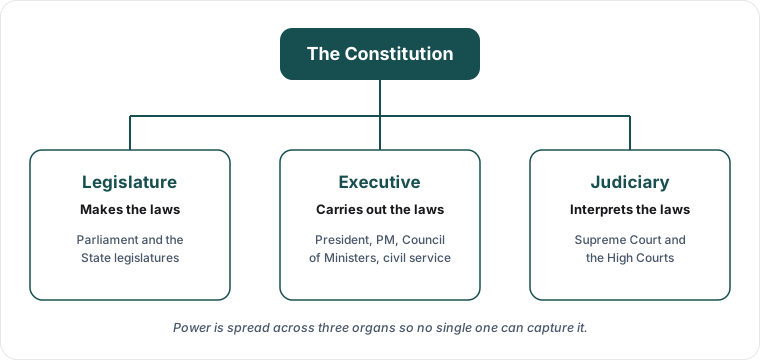
The Indian Constitution also limits power by spreading it across three organs of the state, so that no single one can capture it:
Making of the Indian Constitution
The Indian Constitution was framed by the Constituent Assembly, set up under the Cabinet Mission Plan of 1946. Its total strength was to be 389: 296 members from British India and 93 from the princely states, roughly one member for every million people. In the 1946 elections the Congress won the bulk of the seats. The Muslim League won the seats reserved for Muslims and later boycotted the Assembly. Note carefully the two dates students most often confuse:
- The Assembly first met on 9 December 1946 and worked for nearly three years, across some 11 sessions.
- It adopted (passed) the Constitution on 26 November 1949 (now observed as Constitution Day).
- The Constitution came into force on 26 January 1950 (chosen to honour the 1930 "Purna Swaraj" pledge), the day it fully commenced. A few provisions on citizenship, elections and the Provisional Parliament had taken effect earlier, on 26 November 1949 itself.
The members were not chosen by universal vote. They were elected indirectly by the provincial assemblies under a limited franchise, but the Assembly still tried hard to represent every section of society. Key office-bearers worth remembering:
- Dr. Sachchidananda Sinha: provisional president when the Assembly opened on 9 December 1946.
- Dr. Rajendra Prasad: elected the permanent President of the Constituent Assembly. He later became the first President of India when the Constitution came into force.
- Dr. B. R. Ambedkar: Chairman of the Drafting Committee (the seven-member body that prepared the draft). Its members included Alladi Krishnaswami Iyer, K. M. Munshi and N. Gopalaswami Ayyangar. Ambedkar is regarded as the chief architect of the Constitution.
- B. N. Rau: Constitutional Adviser who prepared the initial draft.
The drafting itself was a marathon. B. N. Rau's initial draft had 240 clauses and 13 schedules. The Drafting Committee refined it into a draft of 315 articles and 9 schedules, which was published for public comment and then debated clause by clause. Around 7,000 amendments were proposed and about 2,500 were discussed. The whole task took 2 years, 11 months and 18 days. The scholar Granville Austin noted that the Assembly worked by consensus: decisions by near-unanimity rather than by overruling dissent. He also noted that a handful of leaders (Nehru, Patel, Rajendra Prasad and Azad) formed a "virtual oligarchy" guiding the Assembly, with the Congress Working Committee the real architect. Members signed the Constitution on 24 January 1950. The Assembly also adopted the National Flag, the National Anthem and the National Song, and it continued as the provisional Parliament until the first general elections.
The finished document was an unusually large one: free India gave itself the longest written constitution in the world. It began with a Preamble and originally had 395 Articles in 22 Parts and 8 Schedules (it has since grown well past that). Its layout is itself tested in examinations: Municipalities sit in Part IX-A, Emergency provisions in Part XVIII, and the amendment procedure (Article 368) in Part XX.
Its real strength lay in how it worked. The members did not simply push their own interests. They gave reasons for their views and tried to reach agreement. This practice of public reason gave the Constitution its authority. The Assembly also drew on the values of the long freedom struggle. Nehru summed these up in the Objectives Resolution he moved on 13 December 1946. It laid down the guiding principles and philosophy of the Constitution: a sovereign republic with power flowing from the people. That resolution later became the basis of the Preamble.
Borrowed and adapted provisions
The makers of the Constitution studied many other countries, but they did not copy blindly. Each borrowed idea was adapted to suit Indian needs:
United Kingdom contributed several foundational features:
- Parliamentary government: the Westminster model of cabinet and legislature.
- Law-making procedure: the process by which Bills pass through Parliament.
- The rule of law: government itself is bound by law.
- Single citizenship: one citizenship for all of India.
- The cabinet system: collective responsibility of the council of ministers.
United States contributed key liberal-democratic safeguards:
- Fundamental Rights: a justiciable bill of rights for individuals.
- An independent judiciary: insulated from executive control.
- Judicial review: courts can strike down laws that violate the Constitution.
- Procedure for removing judges: impeachment of Supreme Court and High Court judges.
Canada contributed the federal architecture:
- A federation with a strong centre: central government holds residual authority.
- Residuary powers with the centre: unallocated subjects vest in the Union.
- Appointment of State Governors by the centre: Governors are nominated by the President.
- Advisory jurisdiction of the Supreme Court: the President may seek the court's opinion on questions of law.
Ireland contributed:
- Directive Principles of State Policy: non-justiciable guidelines for governance.
- Method of electing the President: proportional representation by a single transferable vote.
- Nomination of members to the Rajya Sabha: the President nominates twelve members for their expertise.
Australia contributed:
- Cooperative federalism: framework for Centre–State cooperation.
- Freedom of inter-state trade and commerce: goods may move freely across State borders.
- The Concurrent List: subjects on which both Parliament and State legislatures may legislate.
Four more countries gave one or two features each:
- Germany (Weimar): emergency powers, and the suspension of Fundamental Rights during an emergency.
- South Africa: the procedure to amend the Constitution and the election of Rajya Sabha members.
- France: the ideals of liberty, equality and fraternity.
- Japan: the phrase "procedure established by law".
The single largest source, however, was not foreign at all but a home-grown one: the Government of India Act, 1935. The bulk of the administrative detail came from it, most importantly:
- the federal scheme with a three-fold distribution of powers (the Union List, State List and Concurrent List), on which Centre–State relations still rest;
- the office of Governor, the structure of the public services, and much of the emergency machinery.
By taking the best ideas and adapting them, the Assembly built a constitution that fit India.
Previous-year questions
Previous-year question
2024UPSCThe Constitution of India came into force on:
Previous-year question
2024UPSCWhich of the following statements are correct about the Constitution of India?
- Powers of the Municipalities are given in Part IX A of the Constitution.
- Emergency provisions are given in Part XVIII of the Constitution.
- Provisions related to the amendment of the Constitution are given in Part XX of the Constitution.
Select the answer using the code given below:
Previous-year question
2024UPSCWhich of the following statements are correct about the Constitution of India?
- Powers of the Municipalities are given in Part IX-A.
- Emergency provisions are given in Part XVIII.
- Provisions related to the amendment of the Constitution are given in Part XX.
Previous-year question
2023UPSCConsider the following statements in respect of the Constitution Day:
Statement-I: The Constitution Day is celebrated on 26th November every year to promote constitutional values among citizens.
Statement-II: On 26th November, 1949, the Constituent Assembly of India set up a Drafting Committee under the Chairmanship of Dr. B. R. Ambedkar to prepare a Draft Constitution of India. Which one of the following is correct in respect of the above statements?
Previous-year question
2021UPSCConstitutional government means:
Previous-year question
2020UPSCA constitutional government by definition is a:
Previous-year question
2018UPSCWhich of the following are regarded as the main features of the "Rule of Law"?
- Limitations of powers
- Equality before law
- People's responsibility to the Government
- Liberty and Civil Rights
Select the correct answer using the code given below:
Previous-year question
2014UPSCConsider the following statements: A Constitutional Government is one which:
- Places effective restrictions on individual liberty in the interest of State Authority.
- Places effective restrictions on the Authority of the State in the interest of individual liberty.
Which of the statements given above is/are correct?
Previous-year question
2005UPSCConsider the following statements:
- The Constitution of India has 20 parts.
- There are 390 articles in the Constitution of India in all.
- Ninth, Tenth, Eleventh and Twelfth Schedules were added to the Constitution of India by the Constitution (Amendment) Acts.
Which of the statements is/are correct?
Previous-year question
1998UPSCThe Indian parliamentary system is different from the British parliamentary system in that India has:
The Schedules of the Constitution
The Constitution ends with its Schedules: tables and lists that hold the detail too long for the articles themselves. The original document had 8 Schedules. Amendments have raised the number to 12. Examiners test the Schedules by number, so each must be tied to its content:
- First Schedule: lists the names of the States and Union Territories and specifies their territories. Whenever a new State is created, this Schedule must be amended.
- Second Schedule: salaries and emoluments of constitutional offices such as the President, Governors, judges and the Speaker.
- Third Schedule: forms of oaths and affirmations for office-holders.
- Fourth Schedule: allocates seats in the Council of States (Rajya Sabha, the upper house of Parliament) among the States and Union Territories. It does not distribute powers and it does not list languages.
- Fifth Schedule: administration of Scheduled Areas and Scheduled Tribes in most States.
- Sixth Schedule: administration of the tribal areas of Assam, Meghalaya, Tripura and Mizoram through autonomous district councils.
- Seventh Schedule: the three legislative lists, the Union List, the State List and the Concurrent List, which divide subjects between the Centre and the States.
- Eighth Schedule: the languages recognised by the Constitution, now 22.
- Ninth Schedule: the protected list of laws created by the First Amendment of 1951.
- Tenth Schedule: the anti-defection law, which disqualifies legislators who defect from their party. It was added by the 52nd Amendment of 1985.
- Eleventh and Twelfth Schedules: the functions of panchayats and municipalities, added by the 73rd and 74th Amendments of 1992.
One cross-cutting question is which provisions bear on education. The answer is surprisingly wide. The Directive Principles direct the State towards free education. The rural and urban local bodies run schools under the Eleventh and Twelfth Schedules. The Fifth and Sixth Schedules cover education in tribal areas. And the Seventh Schedule places education on the Concurrent List, so both Parliament and the State legislatures may legislate on it. All of these provisions therefore have a bearing on education.
Previous-year questions
Previous-year question
2012UPSCWhich of the following provisions of the Constitution of India have a bearing on Education?
- Directive Principles of State Policy
- Rural and Urban Local Bodies
- Fifth Schedule
- Sixth Schedule
- Seventh Schedule
Select the correct answer using the codes given below:
Previous-year question
2004UPSCWhich one of the following statements correctly describes the Fourth Schedule of the Constitution of India?
Previous-year question
2003UPSCWhich one of the following schedules of the Indian Constitution lists the names of states and specifies their territories?
Previous-year question
2001UPSCIf a new State of the Indian Union is to be created, which one of the following Schedules of the Constitution must be amended?
Previous-year question
1998UPSCWhich one of the following Schedules of the Constitution of India contains provisions regarding Anti-Defection Act?
Union–State relations
The federal scheme needs rules for how the two levels of government deal with each other. The administrative rules sit in Articles 256 to 263, and two emergency-linked articles sit further on. The tested articles are these:
- Article 256: every State must exercise its executive power so as to comply with the laws made by Parliament.
- Article 257: the executive power of every State shall be so exercised as not to impede or prejudice the exercise of the executive power of the Union. The Union may give directions to a State for this purpose.
- Article 258: the Union may entrust its functions to a State with the consent of that State.
- Article 355: it is the duty of the Union to protect every State against external aggression and internal disturbance, and to ensure that the government of every State is carried on in accordance with the Constitution.
- Article 356: if a State government cannot be carried on in accordance with the Constitution, the President may assume its functions (President's Rule).
Keep the pairs distinct. Article 257 restrains the States: their executive action must not obstruct the Union. Article 355 obliges the Union: it must shield every State from aggression and disturbance. Article 355 supplies the constitutional justification for Article 356, but the duty and the takeover are separate provisions.
Previous-year questions
Previous-year question
2004UPSCWhich one of the following Articles of the Constitution of India says that the executive power of every State shall be so exercised as not to impede or prejudice the exercise of the executive power of the Union?
Previous-year question
2003UPSCWhich one of the following Articles of the Indian Constitution provides that 'It shall be the duty of the Union to protect every State against external aggression and internal disturbance'?
Evolution of Indian Constitution
The Indian Constitution did not appear all at once in 1950. Its framework grew over nearly two centuries through a long line of Acts passed by the British Parliament and applied in India. Some of these served British interests. Others were won by the pressure of India's freedom movement. The key milestones, from the first such Act down to independence, are traced below.
- 1773
Regulating Act
First British move to control the Company. Governor of Bengal became Governor-General of Bengal (Warren Hastings); a Supreme Court was set up at Calcutta (1774).
- 1784
Pitt's India Act
Named after British PM William Pitt. Created a Board of Control over the Company and separated its commercial work from its political work; its territories were now called the 'British Possessions in India'.
- 1813
Charter Act
Ended the Company's monopoly over trade with India and allowed Christian missionaries in.
- 1833
Charter Act
Governor-General of Bengal became Governor-General of India (William Bentinck); created a single Government of India.
- 1853
Charter Act
Separated the legislative and executive work of the council; opened the civil service to open competition.
- 1858
Government of India Act
After the 1857 Revolt, rule passed from the Company to the Crown, and India was split into British India and the Princely States. A Secretary of State (a member of the British Cabinet) now governed, and the Governor-General also became Viceroy — Lord Canning was the first.
- 1861
Indian Councils Act
Began representative institutions — Indians admitted as non-official members of the councils.
- 1892
Indian Councils Act
Enlarged the councils and introduced a limited, indirect form of election.
- 1909
Indian Councils Act (Morley-Minto)
Expanded the councils and granted a separate electorate to Muslims.
- 1919
Government of India Act (Montagu-Chelmsford)
Introduced dyarchy in the provinces — a 'transferred list' (agriculture, health, education) run by Indian ministers and a 'reserved list' (defence, foreign affairs) kept by the Governor — and made the central legislature bicameral.
- 1927
Simon Commission
An all-British body to review the 1919 Act; boycotted by every Indian party as it had no Indian member.
- 1928
Nehru Report
A committee under Motilal Nehru proposed a constitution with dominion status and a Bill of Rights.
- 1935
Government of India Act
The longest such Act and a main source of the present Constitution: an all-India federation, three lists (Federal, Provincial, Concurrent), provincial autonomy and the RBI. The federation never came into being, as the princely states did not join.
- 1940
August Offer
Promised that Indians would frame their own constitution after the war.
- 1942
Cripps Mission
Offered a Constituent Assembly elected by Indians and dominion status after the war.
- 1946
Cabinet Mission
Laid down the plan for the Constituent Assembly that would actually write the Constitution.
- 1947
Mountbatten Plan & Indian Independence Act
Accepted partition and divided British India into the dominions of India and Pakistan (the Act came into force on 18 July 1947). Sir Cyril Radcliffe drew the boundary, and the office of Viceroy was abolished.
Previous-year questions
Previous-year question
2012UPSCThe distribution of powers between the Centre and the States in the Indian Constitution is based on the scheme provided in the:
The Constitution as a living document
A constitution must be able to change with the times, yet not so easily that it loses its authority. The Indian Constitution manages both. It is firm and flexible: Parliament can amend it and courts can reinterpret it, but its basic vision stays the same. That is why a single constitution has served India since 1950, while some countries have rewritten theirs many times.
How to amend the Constitution
Article 368 lays down how the Constitution may be amended. All amendments must begin in Parliament. There is no separate constitutional convention and no referendum of the people. The Constitution can be amended in three ways, depending on the part being changed:
- Simple majority: some articles can be changed like an ordinary law. These parts are very flexible.
- Special majority: most articles need a special majority of each house, at least half of its total membership and at least two-thirds of those present and voting.
- Special majority + the States: a few articles touch the federal balance and also need ratification by the legislatures of at least half the States. This protects the States, whose powers the centre cannot change alone.
Article 368 itself names the provisions that need this ratification by half the State legislatures. The list is tested often, so learn it as a set:
- Election of the President: the manner of election under Articles 54 and 55.
- Executive power: the extent of the executive power of the Union and of the States.
- The higher judiciary: provisions on the Supreme Court and the High Courts.
- The Seventh Schedule: any change to the Union, State or Concurrent List.
- Representation of States in Parliament: the allocation of seats among the States.
- Article 368 itself: the amendment procedure.
Anything outside this list needs no ratification, however federal it may sound. The conditions of the Governor's office and the abolition of a State Legislative Council, two favourite traps, are changed without the consent of the States.
The mechanics of a Constitution Amendment Bill also differ from an ordinary bill in three tested ways. First, it may be introduced in either house of Parliament without the prior recommendation of the President. Second, once both houses pass it, the President is obliged to give assent: the 24th Amendment of 1971 made this assent mandatory. Third, there is no provision for a joint sitting if the two houses disagree. Each house must pass the bill separately by the special majority.
Why so many amendments
The Constitution has been amended more than a hundred times. This may seem a lot for a document that is hard to change. But the amendments fall into a few simple groups, and most are not attacks on the Constitution:
- Technical: small clarifications or extensions, such as raising the retirement age of High Court judges or extending reserved seats by another ten years.
- Settling Parliament–judiciary disputes: when the two read the Constitution differently, Parliament has amended it to fix one reading. This happened often between 1970 and 1975.
- Political consensus: changes that grew into broad agreement, such as the anti-defection law, lowering the voting age from 21 to 18, and the creation of local governments.
- Controversial: above all the 42nd Amendment of 1976, passed during the Emergency, which tried to change many crucial parts at once. The 43rd and 44th Amendments later undid most of it.
One amendment matters enough to remember on its own: the First Amendment of 1951, passed under Prime Minister Jawaharlal Nehru. It created the Ninth Schedule (under Article 31B). This was a protected list into which laws, chiefly land-reform laws, could be placed to shield them from being struck down by the courts for violating Fundamental Rights. This protection is no longer absolute. In I. R. Coelho (2007) the Supreme Court held that any law added to the Ninth Schedule after 24 April 1973 (the date of the Kesavananda judgment) can still be tested against the basic structure.
A few other amendments are tested by their numbers, so tie each number to its content:
- 69th Amendment (1991): gave Delhi a special status as the National Capital Territory, with its own legislative assembly.
- 75th Amendment (1994): provided for the setting up of Rent Tribunals at the State level to cut down rent litigation in civil courts.
- 80th Amendment (2000): implemented the Tenth Finance Commission's scheme for sharing Central tax revenue with the States.
- 83rd Amendment (2000): exempted Arunachal Pradesh from reservation for the Scheduled Castes in its panchayats, since the State has no Scheduled Caste population.
The basic structure doctrine
The most important idea in the growth of the Constitution is the doctrine of the basic structure. The Supreme Court set it out in the Kesavananda Bharati case of 1973. The doctrine holds that Parliament can amend any part of the Constitution but cannot damage its basic structure. The court keeps for itself the right to decide what belongs to that basic structure.
Exam tip
Kesavananda Bharati (1973) is the landmark that established the basic structure doctrine: Parliament can amend any article (Art 368) but cannot destroy the Constitution's basic structure.
The basic structure doctrine is itself an example of a living constitution. The phrase basic structure appears nowhere in the text. Yet it has guided every reading of the Constitution since 1973 and has been accepted by all political parties and institutions.
Judicial review stands on a similar footing, and the distinction is tested. The Constitution nowhere says in express words that the courts may review the constitutionality of laws or amendments. The power is inferred, above all from Article 13, which declares void any law inconsistent with the Fundamental Rights, read together with other articles. A statement that the Constitution "explicitly provides for judicial review" is therefore treated as incorrect, just like a statement that the text contains the words "basic structure". The courts exercise both powers, but neither is spelt out in the document.
There is also a procedural rule worth knowing. When the constitutionality of a constitutional amendment is challenged, the case is referred to a Constitution Bench of the Supreme Court: a bench of at least five judges, which Article 145(3) requires for any case involving a substantial question of constitutional interpretation. By protecting the core while allowing change elsewhere, the doctrine has balanced the rigid and the flexible sides of the Constitution. The judiciary has shaped the Constitution in other ways too, such as the rule that reservations should not cross half of the total seats. In this way the courts have added to the Constitution without any formal amendment.
Previous-year questions
Previous-year question
2025UPSCConsider the following subjects under the Constitution of India: I. List I–Union List, in the Seventh Schedule II. Extent of the executive power of a State III. Conditions of the Governor's office For a constitutional amendment with respect to which of the above, ratification by the Legislatures of not less than one-half of the States is required before presenting the bill to the President of India for assent?
Previous-year question
2024UPSCAs per Article 368 of the Constitution of India, the Parliament may amend any provision of the Constitution by way of:
- Addition
- Variation
- Repeal
Select the correct answer using the code given below:
Previous-year question
2024UPSCThe 'basic structure' doctrine of the Constitution was propounded by the Supreme Court in which case?
Previous-year question
2022UPSCConsider the following statements:
- A bill amending the Constitution requires a prior recommendation of the President of India.
- When a Constitution Amendment Bill is presented to the President of India, it is obligatory for the President of India to give his/her assent.
- A Constitution Amendment Bill must be passed by both the Lok Sabha and the Rajya Sabha by a special majority and there is no provision for joint sitting.
Which of the statements given above are correct?
Previous-year question
2021UPSCWe adopted parliamentary democracy based on the British model, but how does our model differ from that model? 1) As regards legislation, the British Parliament is supreme or sovereign but in India, the power of the Parliament to legislate is limited. 2) In India, matters related to the constitutionality of the Amendment of an Act of the Parliament are referred to the Constitution Bench by the Supreme Court. Select the correct answer using the code given below.
Previous-year question
2020UPSCConsider the following statements:
- The Constitution of India defines its 'basic structure' in terms of federalism, secularism, fundamental rights and democracy.
- The Constitution of India provides for 'judicial review' to safeguard the citizens' liberties and to preserve the ideals on which the Constitution is based.
Which of the statements given above is/are correct?
Previous-year question
2019UPSCThe Ninth Schedule was introduced in the Constitution of India during the prime ministership of:
Previous-year question
2018UPSCConsider the following statements:
- The Parliament of India can place a particular law in the Ninth Schedule of the Constitution of India
- The validity of law placed in Ninth Schedule cannot be examined by any court and no judgement can be made on it.
Which of the statements given above is/are correct?
Previous-year question
2013UPSCConsider the following statements:
- An amendment to the constitution of India can be initiated by an introduction of a bill in the Lok Sabha only.
- If such an amendment seeks to make changes in the federal character of the constitution, the amendment also requires it to be ratified by the legislature of all the states of India.
Which of the statements given above is/are correct?
Previous-year question
2003UPSCThe Ninth Schedule to the Indian Constitution was added by:
Previous-year question
2001UPSCMatch List I with List II and select the correct answer using the codes given below the Lists: List I (Amendments to the Constitution) — List II (Contents) I. The Constitution (Sixty Ninth Amendment) Act, 1991 — A) Establishment of State level Rent Tribunals II. The Constitution (Seventy Fifth Amendment) Act, 1994 — B) No reservations for Scheduled Castes in Panchayats in Arunachal Pradesh III. The Constitution (Eightieth Amendment) Act, 2000 — C) Constitution of Panchayats in Villages or at other local levels IV. The Constitution (Eighty Third Amendment) Act, 2000 — D) Accepting the recommendations of the Tenth Finance Commission — E) According the status of National Capital Territory to Delhi Codes:
Previous-year question
1999UPSCAn amendment of the Constitution of India can be initiated by the: I. Lok Sabha. II. Rajya Sabha. III. State Legislatures. IV. President.
Previous-year question
1995UPSCWhich of the following are matters on which a constitutional amendment is possible only with the ratification of the legislatures of not less than one half of the States? I. Election of the President II. Representation of States in Parliament III. Any of the Lists in the 7th Schedule IV. Abolition of the Legislative Council of a State
The philosophy of the Constitution
A constitution is more than a set of legal rules. Behind its rules lies a vision of the kind of society the country wishes to build. A law that forbids discrimination, for example, rests on the value of equality. To understand the Indian Constitution fully, the reader must look at the moral vision behind its articles. This vision is called the philosophy of the Constitution. It cannot be caught in a single word. It is liberal, democratic, egalitarian, secular and federal all at once. It is committed to social justice, to the rights of minorities and to a common national identity. This identity is to be reached by peaceful and democratic means.
Reading the Constitution as a moral document
To read the Constitution as a moral document is to take a political philosophy approach to it. This means asking what its key terms, such as rights, citizenship and democracy, really mean. It also means working out the vision of society that lies behind them. And it means reading the Constitution together with the debates of the Constituent Assembly, where the makers explained the reasons for their choices.
There is a special reason for going back to those debates in India. The values of the makers and the values of the present day have not drifted far apart. So the history of the Constitution is still the history of the present. A constitution also serves to limit the great power of the modern state and to prevent it from turning tyrannical. More than that, the Indian Constitution was meant to transform society. It was meant to break old hierarchies and to give power to groups that had long been denied it.
Core features
The Constitution rests on a set of core values:
- Individual freedom: the national movement demanded a free press and freedom from arbitrary arrest, so the Constitution gives individual rights a firm place.
- Social justice: Indian liberalism was always tied to the good of the community. The clearest example is reservation of seats and jobs for the Scheduled Castes and Scheduled Tribes.
- Diversity and minority rights: a land of many religious and linguistic communities, so it grants rights to communities as well as individuals, such as a minority's right to run its own schools.
- Universal adult franchise: India gave every adult the vote from the very start, when many older democracies had only recently extended it to women and the poor.
- Federalism: a strong centre, yet with special arrangements for certain States (asymmetric federalism).
The care for linguistic minorities is written into a cluster of language articles that are easy to confuse, so keep the three apart:
- Article 350: every person may submit a representation for the redress of a grievance to any Union or State authority in any language used in the Union or in the State.
- Article 350-A: every State and local authority shall endeavour to provide adequate facilities for instruction in the mother tongue at the primary stage to children of linguistic minority groups.
- Article 351: a directive to the Union to promote the spread and development of Hindi.
Article 350-A is the provision on mother-tongue instruction. It is the one examiners pair with the value of minority rights.
Secularism in the Constitution
Indian secularism is not quite the same as the western model. In the common western view the state and religion stay strictly apart. The state neither helps nor hinders any religion. The Indian Constitution follows a different path for two reasons.
First, the Constitution treats equality between communities as being as important as equality between individuals. So it grants rights to religious communities, such as the right to set up and run their own schools. Second, Indian secularism allows the state to step into religion when justice requires it. A custom such as untouchability was so deeply rooted that only active intervention by the state could end it. The state may therefore help a religious community at one time and restrain it at another. This balanced approach is called principled distance. It lets the state keep its distance from all religions and step in or stay out as freedom and equality demand.
Procedural achievements
The Constitution is admired not only for its values but also for the way it was made. The makers placed their faith in open discussion. The debates of the Constituent Assembly show a willingness to listen and to give reasons rather than pursue narrow self-interest. They also show a willingness to treat disagreement as something of value.
The making of the Constitution also showed a spirit of compromise and accommodation. Not every compromise is a bad one. When one worthy value is partly traded for another in an open debate among equals, the result deserves respect rather than blame. The makers preferred to settle the most important questions by consensus, not by a bare majority vote.
Criticisms and limitations
The Constitution has faced three main criticisms:
- Too bulky: it gathers into one document many details that other countries leave outside their constitutions.
- Unrepresentative: the Constituent Assembly was chosen by a limited franchise, not by all adults, though a wide range of opinions was still heard.
- An alien document: copied from the West. The makers did borrow freely, but adapted what they borrowed, so the borrowing was creative rather than blind.
It also has real limitations that its admirers admit:
- a centralised idea of national unity;
- it does not deal fully with justice for women within the family;
- it places important social and economic rights in the Directive Principles (non-justiciable) rather than among the Fundamental Rights.
These weaknesses are real, but not grave enough to spoil the larger vision of the Constitution.
Previous-year questions
Previous-year question
2023UPSCWhich one of the following statements best reflects the Chief purpose of the 'Constitution' of a country?
Previous-year question
2020UPSCA Constitutional government by definition is a:
Previous-year question
2014UPSCA Constitutional Government is one which:
- places effective restrictions on individual liberty in the interest of State Authority.
- places effective restrictions on the Authority of the State in the interest of individual liberty.
Previous-year question
2001UPSCWhich Article of the Constitution provides that it shall be the endeavour of every State to provide adequate facility for instruction in the mother tongue at the primary stage of education?
Previous-year question
1999UPSCThe Constitution of India recognises:
The National Flag
The Constitution's vision of a shared identity has its most visible symbol in the National Flag, the tricolour of saffron, white and green with the navy blue Ashoka Chakra of 24 spokes at the centre. The Constituent Assembly adopted the flag on 22 July 1947, before independence. Its design is based on the work of Pingali Venkayya.
The display of the flag is governed by the Flag Code of India, 2002, a compilation of the laws and conventions on the flag that came into effect on 26 January 2002. Two of its rules are tested together:
- Shape: the flag must always be rectangular, and the ratio of its length to its height (width) shall be 3:2.
- Standard sizes: the Code lists exactly nine standard sizes, from 6300 x 4200 mm down to 150 x 100 mm. A size such as 600 x 400 mm satisfies the 3:2 ratio but is not one of the nine listed sizes. The ratio rule and the size list are therefore independent requirements, and meeting one does not mean meeting the other.
Two later changes to the Code are worth noting. A 2021 amendment allowed machine-made and polyester flags in addition to hand-spun khadi. A 2022 amendment allowed a flag displayed in the open or on a home to fly day and night.
Previous-year questions
Previous-year question
2023UPSCConsider the following statements in respect of the National Flag of India according to the Flag Code of India, 2002:
Statement-I: One of the standard sizes of the National Flag of India is 600 mm x 400 mm.
Statement-II: The ratio of the length to the height (width) of the Flag shall be 3:2. Which one of the following is correct in respect of the above statements?
Key takeaways
- Constitution = basic rules so a diverse people live together in peace
- Five functions: coordination, allots power, limits government, sets goals, shared identity
- Constitutionalism = limited government (restrains the state for individual liberty)
- Evolved through British-era Acts (1773–1947)
- Key Acts: 1858 (Crown rule), 1935 (main source), 1947 (two dominions)
- Longest written constitution in the world
- Demand: M.N. Roy's idea; Nehru's formal call (1933); Congress policy 1934
- Nehru Report (1928): outline constitution by Indians
- Cripps Proposals (1942) conceded a constituent assembly
- Assembly strength 389 under Cabinet Mission Plan; Sinha provisional president
- Constituent Assembly first met 9 Dec 1946; adopted 26 Nov 1949; in force 26 Jan 1950
- Ambedkar chaired Drafting Committee; Rajendra Prasad presided; Objectives Resolution → Preamble
- Objectives Resolution: Nehru, 13 December 1946
- Drafting took 2 years 11 months 18 days; ~7,000 amendments
- Austin: consensus method; four-leader "virtual oligarchy"
- Rajendra Prasad first President; Assembly became provisional Parliament
- Parts tested: IX-A municipalities, XVIII emergency, XX amendment (Art 368)
- Biggest source = GoI Act 1935 (three-list Centre–State scheme)
- Borrowed widely: UK (parliament), US (rights & review), Canada (federation), Ireland (DPSP), Germany (emergency)
- 1st Amendment (1951, Nehru): Ninth Schedule / Art 31B; post-1973 entries reviewable (Coelho 2007)
- Living document: amendable and reinterpreted, core vision intact since 1950
- Article 368: three amendment routes (simple, special, special + States)
- Amended 100+ times; mostly technical; the 42nd was controversial
- Basic structure doctrine (Kesavananda, 1973): can't damage the basic structure
- Behind the rules: a moral vision (liberal, democratic, secular, federal)
- Core: freedom, social justice, diversity, minority rights, adult franchise, federalism
- Indian secularism = principled distance (state may intervene for justice)
- Criticised as bulky/alien; real limits but the vision holds
- State = territory + people + government + sovereignty; boycott named after Capt. Boycott
- Marx: dialectical materialism; Gandhism & Marxism share stateless-society goal
- Schedules: 1st States/territories, 4th Rajya Sabha seats, 10th anti-defection (52nd, 1985)
- Education touches DPSP, local bodies, 5th/6th/7th Schedules
- Art 257: State must not impede Union; Art 355: Union protects States
- Half-States ratification: President's election, SC/HCs, Seventh Schedule, Art 368
- Governor's conditions, abolishing a Legislative Council: no ratification needed
- Amendment bill: no joint sitting; President must assent (24th Amdt)
- Amendment challenges go to five-judge Constitution Bench (Art 145(3))
- Judicial review inferred from Art 13, not explicitly provided
- 69th: Delhi NCT; 80th: tax devolution; 83rd: Arunachal SC exemption
- Art 350-A: mother-tongue primary instruction for linguistic minorities
- Flag Code 2002: ratio 3:2; nine standard sizes only
You’ve reached the end of this topic.
Review the takeaways above, then mark it done.